Off-Grid vs On-Grid Solar: Which Fits Your Needs in India?
Solar energy is rapidly transforming how Indian households, businesses, and communities access electricity. With rising energy costs, frequent power outages in certain areas, and the push toward renewable energy, solar power has become a viable and sustainable solution.
However, when considering solar for your home or business, one major decision arises: Should you go for an off-grid connected solar system or an on-grid system? Understanding the differences, benefits, and limitations of both is crucial to making the right choice.
In this comprehensive guide, we will explore the concepts of off-grid and on-grid solar, their applications in India, cost considerations, maintenance, and which system suits your energy needs.
What Is a Solar System?
A solar system converts sunlight into electricity using solar photovoltaic (PV) panels. The generated electricity can be used immediately, stored in batteries, or fed into the grid, depending on the type of system installed.
Key components of a solar system include:
- Solar PV Panels: Capture sunlight and convert it into DC electricity.
- Inverter: Converts DC to AC electricity for household or commercial use.
- Charge Controller (for off-grid systems): Manages battery charging to prevent overcharging.
- Batteries (for off-grid systems): Store excess energy for use during non-sunlight hours.
- Net Meter (for on-grid systems): Tracks energy exported to and imported from the grid.
The distinction between off-grid and on-grid systems mainly revolves around how electricity is stored and connected to the utility grid.
Understanding On-Grid Solar Systems
An on-grid solar system, also called a grid-tied solar system, is connected to the electricity utility grid. Here’s how it works:
- Solar panels generate electricity for immediate household or business use.
- Excess electricity is fed back into the grid, and the homeowner receives credit via net metering.
- During nighttime or cloudy days, electricity is drawn from the grid as usual.
Advantages of On-Grid Solar Systems
- Lower Initial Cost: No batteries required, reducing upfront investment.
- Net Metering Benefits: Export excess electricity and offset your electricity bill.
- Smaller Footprint: No need for bulky battery banks.
- Simplicity: Easier installation and maintenance compared to off-grid systems.
Limitations of On-Grid Solar Systems
- No Power During Grid Outages: If the grid fails, electricity stops, unless paired with a hybrid battery system.
- Dependent on Grid Policies: Net metering rules and tariffs may vary by state.
Ideal for: Urban households, businesses, and areas with reliable electricity supply.
Understanding Off-Grid Solar Systems
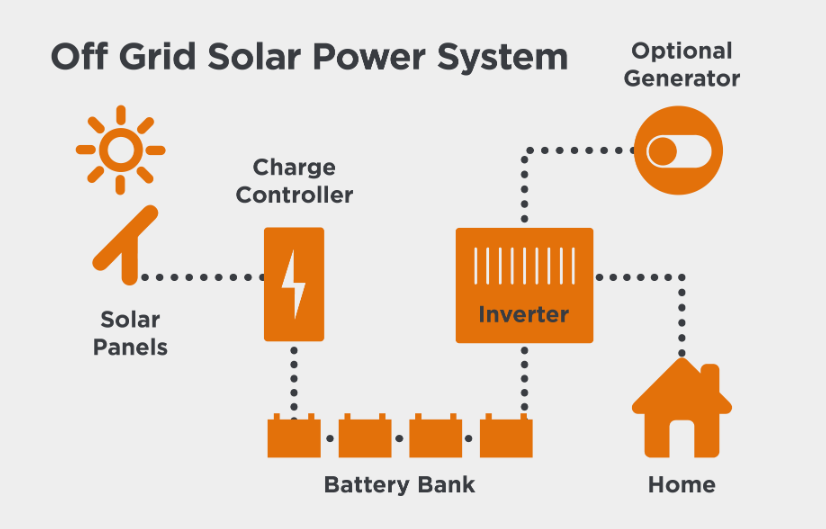
An off-grid connected solar system operates independently of the electricity utility grid. It stores solar energy in batteries for use whenever needed, making it ideal for areas with unreliable or no grid connection.
How an Off-Grid Connected Solar System Works
- Solar panels capture sunlight and generate DC electricity.
- The charge controller manages energy storage in batteries, preventing overcharging.
- Inverter converts stored DC electricity to AC for household or commercial appliances.
- Electricity is available 24/7, even during nighttime or grid outages.
Advantages of Off-Grid Solar Systems
- Energy Independence: Complete control over electricity generation and consumption.
- Reliable Power Supply: Provides electricity in remote or rural areas without grid access.
- Customization: Battery capacity and solar panel size can be tailored to your energy needs.
- Resilience During Blackouts: Ensures uninterrupted power supply for critical loads.
Limitations of Off-Grid Solar Systems
- Higher Initial Cost: Batteries increase the upfront investment.
- Maintenance: Battery upkeep is required to maintain efficiency and longevity.
- Space Requirements: Larger systems need more rooftop or ground space for panels and batteries.
Ideal for: Remote homes, rural areas, farms, and businesses seeking energy independence.
Key Differences Between On-Grid and Off-Grid Solar
| Feature | On-Grid Solar System | Off-Grid Connected Solar System |
| Grid Connection | Connected to the utility grid | Operates independently |
| Batteries | Not required (optional for hybrid) | Required for energy storage |
| Electricity Availability | Only when sun + grid are available | 24/7 availability via batteries |
| Cost | Lower upfront cost | Higher upfront cost due to batteries |
| Maintenance | Minimal | Requires battery maintenance |
| Ideal Locations | Urban, areas with reliable grid | Remote or rural areas, critical loads |
| Energy Independence | Low | High |
| Net Metering | Yes | Not applicable |
Choosing the Right System for Indian Homes
India’s diverse climate, energy availability, and electricity costs mean that the choice between on-grid and off-grid solar depends on multiple factors:
1. Electricity Reliability
- Urban Areas (Mumbai, Delhi, Bangalore): Mostly stable grid supply; on-grid solar is usually sufficient.
- Rural Areas (Villages in Rajasthan, Odisha, Chhattisgarh): Frequent outages or no grid; off-grid systems are more suitable.
2. Energy Needs
- Small households: On-grid solar is cost-effective.
- Homes with high-demand appliances or critical loads: Off-grid or hybrid solar systems ensure uninterrupted power.
3. Roof or Land Space
- On-grid systems are smaller and more efficient for limited rooftop areas.
- Off-grid systems require extra space for batteries in addition to panels.
4. Budget
- On-grid: Lower initial investment, quicker ROI via net metering.
- Off-grid: Higher initial investment due to batteries, but long-term independence and reliability.
5. Long-Term Goals
- Energy Independence & Resilience: Off-grid connected solar system.
- Cost Savings & Simplicity: On-grid system with net metering.
Cost Considerations in India
On-Grid Solar System Costs
- Small 3 kW home system: ₹1.8–2.5 lakh (excluding installation)
- Medium 5 kW system: ₹3–4 lakh
- Payback period: 3–5 years depending on electricity consumption
Off-Grid Connected Solar System Costs
- Small 3 kW off-grid system with battery backup: ₹3.5–4.5 lakh
- Medium 5 kW system: ₹5–6.5 lakh
- Payback period: 5–7 years (but provides energy independence)
Government Subsidies
- The MNRE and various state governments offer subsidies for solar PV installations, especially off-grid systems in rural areas or for critical applications.
- Societies and businesses can also apply for low-interest solar loans from banks.
Maintenance of Off-Grid and On-Grid Systems
On-Grid Systems
- Minimal maintenance: Panel cleaning 2–3 times per year.
- Inverter replacement every 8–10 years.
- Net metering checkups periodically.
Off-Grid Connected Solar System
- Requires battery maintenance: Checking electrolyte levels (for lead-acid), ensuring proper charge cycles.
- Regular panel cleaning and inverter checkups.
- Replacement of batteries every 5–10 years depending on type and usage.
Proper maintenance ensures longevity and optimal performance for both systems.
Applications of Off-Grid Connected Solar Systems in India
- Rural Homes: Providing electricity to households without grid connectivity.
- Farms and Agriculture: Powering irrigation pumps, cold storage, and farm equipment.
- Emergency Power Supply: Hospitals, schools, and businesses requiring uninterrupted electricity.
- Remote Businesses: Small industries or shops in areas with unreliable grid power.
Common Myths About Off-Grid Solar Systems
- “They are too expensive.”
While upfront costs are higher, long-term energy independence and avoided electricity bills provide excellent ROI. - “Batteries are unreliable.”
Modern lithium-ion batteries are durable, efficient, and require minimal maintenance. - “On-grid systems are always better.”
Not always. In areas with unreliable electricity or for critical loads, an off-grid connected solar system ensures uninterrupted supply. - “Off-grid solar can’t handle high energy demand.”
Properly sized systems with sufficient battery storage can meet the needs of medium to large households or businesses.
Which System Fits Your Needs?
Choosing between an off-grid connected solar system and an on-grid system depends on your location, electricity reliability, budget, and energy goals.
- On-Grid: Ideal for urban homes with stable grid electricity, focused on cost savings.
- Off-Grid: Perfect for remote homes, critical applications, or those seeking complete energy independence.
At Powertroniks, we understand the diverse energy needs of Indian homes and businesses. Whether you require a reliable off-grid connected solar system for rural or high-demand applications or an efficient on-grid system for urban households, we provide:
- Customized solar solutions tailored to your energy requirements.
- Expert installation and ongoing support.
- Assistance with government subsidies and compliance.
- Durable, high-performance systems that last decades.
We believe in empowering Indian homes and businesses with clean, reliable, and sustainable energy. Let us help you harness the sun’s power with confidence and ease.