What Are Solar Hot Water Systems
Go check your electricity bill from last month. Find the units consumed. Now think about how many of those units went towards heating water you used in 20 minutes.
For most Indian families, it is more than they expect.
Solar hot water systems have been sitting on rooftops across the country for 30-odd years. They are not experimental. They are not complicated. And yet most homeowners treat them as an upgrade for "someday" rather than a decision worth making this year. That gap is worth examining.
What the system actually does on your roof
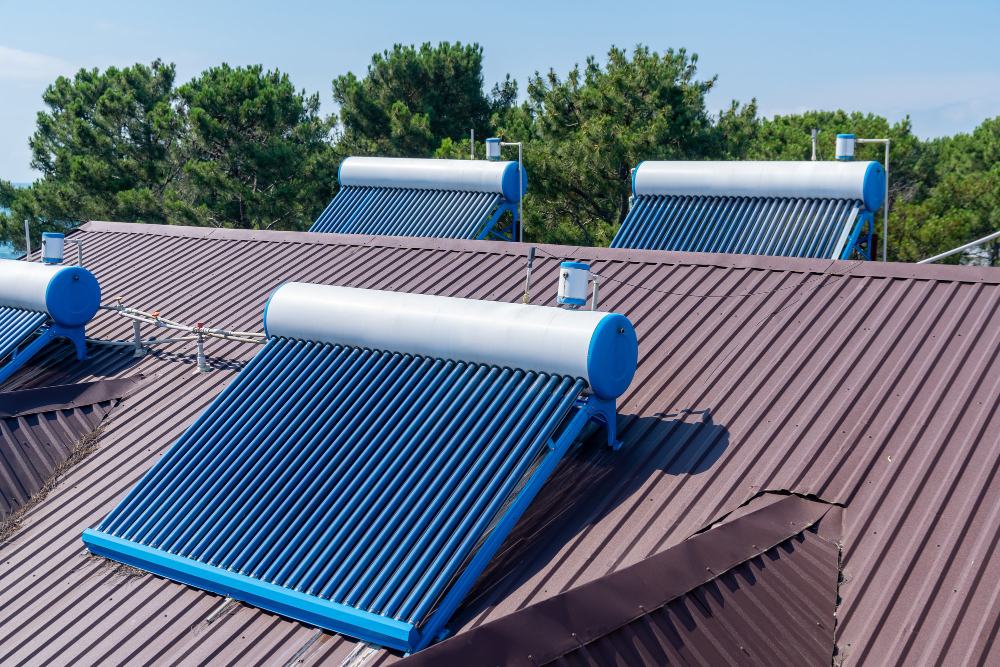
Here is the full explanation: a collector panel on your roof absorbs heat from sunlight and transfers it to water sitting in an insulated tank. That water stays hot. You use it. No electricity consumed for heating.
That is genuinely it.
Two parts. One job. The collector does the capturing, the tank does the storing. In most home installations, thermosyphon physics handles the circulation — hot water rises naturally into the tank, cool water drops back into the collector. No pump. No controller board. Nothing electronic to fail.
Which is why a well-installed residential system from a quality manufacturer routinely runs 15 to 20 years without much attention.
Flat plate or evacuated tube — what is actually different
Two collector technologies dominate the Indian market.
Flat plate collectors use a dark absorber sheet behind toughened glass. The absorber heats up, copper tubes behind it carry that heat to your water. They handle dust, rain, and physical wear reasonably well. For most cities in Maharashtra, Telangana, Karnataka, or Tamil Nadu, they are the sensible choice.
Evacuated tube collectors use a vacuum layer between two glass tubes. The vacuum stops heat from escaping, so they perform better in cold or overcast conditions. More efficient in Chandigarh or Dehradun. More fragile if a cricket ball lands wrong.
If you are in a warm, sunny Indian city, flat plate collectors do the job. If winters get genuinely cold where you live, evacuated tubes earn their price premium.
Sizing it correctly matters more than people realise
Undersizing is the single most common mistake. A system that is 20% too small for your household will produce lukewarm water by the third bathroom and you will blame solar technology when the real problem was the sizing conversation nobody had.
Rough numbers that actually hold up:
- 100 litres per day handles 2 to 3 people comfortably
- 200 litres per day covers a family of 4 or 5 in a standard 2 or 3 BHK
- 300 litres per day and above is where clinics, salons, guesthouses, and larger households land
Most Indian cities get 250 to 300 days of productive sunshine annually. On the remaining days, the backup heating element inside the tank handles the gap. You will not run out of hot water.
Where the money goes and where it comes back
A properly installed 200 LPD solar hot water system from a reliable manufacturer costs between Rs. 25,000 and Rs. 40,000. That number looks large until you put it next to the running cost of an electric geyser.
The average Indian household spends Rs. 800 to Rs. 1,200 per month heating water electrically. At Rs. 1,000 per month, that is Rs. 12,000 per year. The solar system pays itself back in 3 to 4 years. After that, the water heating is effectively free for the next 12 to 15 years.
The MNRE runs subsidy programmes for solar water heating. Maharashtra residents specifically can check what MEDA has active before purchasing — historically the subsidy has knocked 20 to 30 percent off the upfront cost. That changes the payback calculation meaningfully.
The three questions that come up every time
What if it is cloudy for a week straight?
Every quality system has an electrical backup element in the storage tank. Overcast stretches just mean the backup works more. Your morning hot water is not at risk.
Will anything change about the water itself?
Nothing. The water comes from the same supply line, heated differently. No chemical contact, no combustion.
How much maintenance does a rooftop system need?
One annual check is sufficient for most homes. Wiping down the collector surface twice a year helps, especially in cities where air quality leaves a visible layer of dust on surfaces.
The part most people skip when comparing prices
Two systems with the same specs on a product listing are not the same product. Tank weld quality, collector absorber coating durability, insulation grade, and pipe joint fittings are the variables that separate a 5-year system from a 20-year one. You cannot tell from a photograph.
Powertroniks Solar has manufactured solar thermal systems from their Thane facility since 2010. Flat plate and evacuated tube configurations, residential to commercial capacities, with MNRE-standard production and on-ground installation across Maharashtra. They handle the site assessment, the system recommendation, installation, and the subsidy paperwork — not handed off to a third party.
For anyone seriously evaluating a switch, that kind of end-to-end accountability matters more than a lower sticker price.
Next step: one conversation before you decide
If your household matches any of this — daily geyser use, bills above Rs. 3,000 per month, roof access, or a renovation in progress — a site assessment takes an hour and answers every remaining question with actual numbers.
Get in touch with Powertroniks Solar for a free site assessment. No obligation. Just clarity on whether the system fits your home and what the real payback timeline looks like for your specific electricity tariff.
The sun comes up every morning in India. Whether it heats your water is a choice you make once.